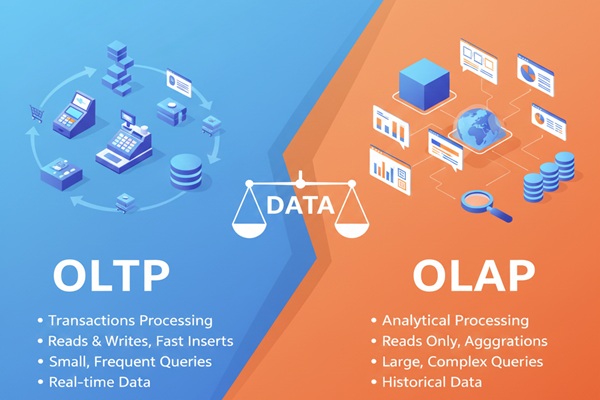
OLTP vs OLAP | Difference Between OLTP And OLAP Explained: Online analytical processing (OLAP) and online transactional processing (OLTP) are two primary data processing systems used in business and organizations of all types.
Before data can be put to use, it must be processed.
OLTP vs OLAP | Difference Between OLTP And OLAP Explained! (With Examples):
The main difference between OLAP and OLTP is the core purpose of each system. An OLAP system can process huge amounts of data quickly, enabling in-depth data analysis across multiple dimensions for decision-making and problem-solving. Teams can use this data for decision-making and problem-solving.
What is OLTP (online transaction processing)?
Every time a customer makes a purchase, updates their profile, or checks their order status, an OLTP database captures that action instantly and accurately.
OLTP databases are built for speed and reliability.
OLTP systems follow ACID principles (Atomicity, Consistency, Isolation, and Durability). This means every transaction either completes fully or not at all.
- Classic examples of OLTP applications include ATM systems, online banking, and credit card processing.
- Other examples include online shopping carts, airline ticket booking systems, and messaging services.
Benefits of OLTP Services:
- High-speed transactions: Handles thousands of small operations per second.
- Data integrity: Follows ACID principles to prevent corruption, even during system failures.
- Current data focus: Always shows the most current state of your operations.
- Normalized structure: Reduces redundancy and maintains consistency across tables.
Drawbacks of OLTP Services:
- Limited analysis capability, not suited for complex analysis or reporting.
- High maintenance costs due to frequent updates, backups and recovery.
- Susceptible to disruption during hardware failures, impacting online transactions.
- Prone to issues like duplicate or inconsistent data.
What is OLAP (online analytical processing)?
Instead of recording what just happened, OLAP helps you see why it happened, like understanding patterns, trends, and relationships across time periods, regions, or product lines.
OLAP databases use column-oriented storage, which makes them incredibly efficient for scanning specific attributes across millions of rows. This architecture allows you to pivot data across multiple dimensions to spot trends that would be impossible to see in raw transactional data.
- An OLAP system can be any form of data warehousing system.
- Common examples of OLAP applications include movie recommendation systems in platforms like Amazon Prime and Netflix, as well as financial performance analysis, marketing trend analysis, and lead management.
Benefits of OLAP Services
- Complex aggregations: Sum sales by region, calculate average customer lifetime value, or track inventory trends.
- Multidimensional analysis: Examine data across time, geography, product categories, and customer segments simultaneously.
- Historical perspective: Store and analyze years of data to identify long-term patterns.
- Denormalized structure: Optimized for read-heavy analytical workloads rather than frequent updates.
Drawbacks of OLAP Services
- Requires professionals to handle the data because of its complex modeling procedure.
- Expensive to implement and maintain in cases when datasets are large.
- Data analysis occurs only after extraction and transformation, leading to system delays.
- Not efficient for decision-making, as it is updated on a periodic basis.
What is HTAP (Hybrid Transactional & Analytical Processing)?
Now, while we might think that all our datastore needs should be answered by either OLTP (for transactional processing) or OLAP (for analytical processing),
our data analytical needs are choked by the legacy Lambda Architecture along with which time and complexity becomes two of the greatest barriers organizations face in realizing the full value of the data, and this is where HTAP (Hybrid Transactional & Analytical Processing) comes to picture.
HTAP systems aim to bridge the gap between OLTP and OLAP by providing a single platform that can handle both transactional and analytical workloads simultaneously.
Various modern cloud data stores enables HTAP functionality one way or the other, like AWS enables us to run Federated Query over the transactional data stores like Aurora & RDS directly from the OLAP like Redshift and also Azure Cosmos DB offer HTAP functionality out-of-the-box.
What are the similarities between OLAP and OLTP?
Both online analytical processing (OLAP) and online transaction processing (OLTP) are database management systems for storing and processing data in large volumes. They require efficient and reliable IT infrastructure to run smoothly. You can use them both to query existing data or store new data. Both support data-driven decision-making in an organization.
Most companies use OLTP and OLAP systems together to meet their business intelligence requirements. However, the approach to and purpose of data management differ significantly between OLAP and OLTP.
Difference Between OLAP and OLTP:
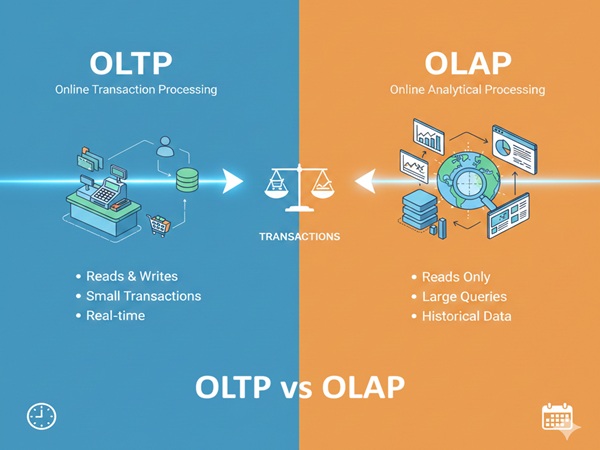
| Category | OLAP (Online Analytical Processing) | OLTP (Online Transaction Processing) |
|---|---|---|
| Data Source | Historical data from multiple databases. | Current operational data. |
| Purpose | Used for analysis and decision-making. | Used for day-to-day transactions. |
| Method Used | Uses a data warehouse. | Uses a standard DBMS. |
| Normalization | Tables are not normalized. | Tables are normalized (3NF). |
| Query Type | Complex, read-heavy queries (slow). | Simple, read/write queries (fast). |
| Data Volume | Large (TB–PB). | Small (MB–GB). |
| Update Frequency | Updated periodically in batches. | Updated frequently by users. |
| Backup & Recovery | Periodic backup. | Continuous and rigorous backup. |
| Users | Used by analysts, managers and executives. | Used by clerks and operational staff. |
| Focus | Subject-oriented (analysis-focused). | Application-oriented (operation-focused). |
Conclusion
In conclusion, OLAP vs OLTP are important for managing data, each serving different roles.Online analytical processing (OLAP) and online transaction processing (OLTP) are two different data processing systems designed for different purposes. OLAP is optimized for complex data analysis and reporting, while OLTP is optimized for transactional processing and real-time updates.
OLTP vs OLAP Frequently Asked Questions:
Q. What is OLTP in SQL?
Ans. OLTP in SQL deals with real-time tasks like adding, updating, or deleting records. It also helps businesses quickly and accurately handle everyday operations like processing orders or updating inventory.
Q.Is SQL Server OLTP or OLAP?
Ans. SQL Server supports both workloads but is primarily optimized for OLTP operations. Its core database engine handles transactional workloads efficiently, while SQL Server Analysis Services (SSAS) provides OLAP capabilities for building data cubes and performing multidimensional analysis.
Q. Is ETL OLAP or OLTP?
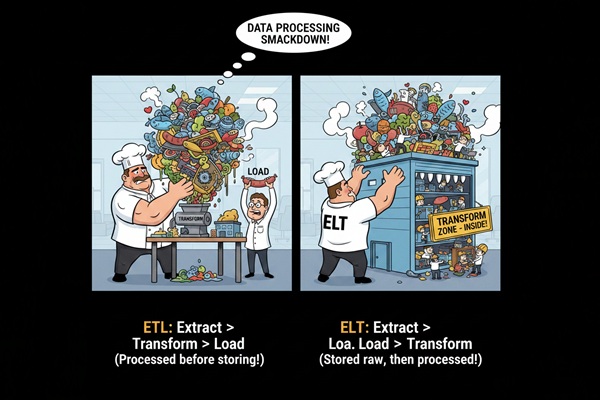
Ans. ETL is related to OLAP. Generally, it gathers data from different places, changes it for analysis, and stores it in a data warehouse where it can be used to create reports and insights.
Q. Is Snowflake OLTP or OLAP?
Ans. Snowflake is used for OLAP. It is a cloud platform for storing and analyzing large amounts of data, helping businesses find trends and make better decisions through complex data analysis.